今天乘搭巴士时,司机突然将巴士停在路旁,他说脚抽筋要伸展一下大腿 。 随着,便问起包括我在内的三名乘客:“你们觉得英国的天气如何?还习惯这种季风吗?”英国人就是喜欢谈天气。
一位看起来像华裔的少女以极浓厚的英国英语搭腔: “我在这里长大,习惯了这种天气。”
巴士司机继说:“噢,我到过很多有季候风的地方,香港、新加坡、马来西亚... ...”听到他说马来西亚,我答说:“是吗?我来自大马,你在那里呆过多久?”
“我以前在那里打共产党,你知道共产党吗?你们的国家独立后,我们还在那里呆到1968年。”
“你们那时不应该再回去。”
“我们是‘协助’(他用手指在空中划了开关影号)马来西亚对付共产党,呵呵... ... 我们在柔佛海峡中央的一个岛屿驻军...”
× × × × ×
我想起去年的圣诞节,我到一户英国人家里做客,那里也有一位英国空军,同样地,他也告诉我,他曾经是专门修理战机的军人,他修的飞机打过很多共产党员... 还获颁过勋章等等。
“其实,我现在回想起来, 日军投降后,我们不该再回去... ... ”
× × × × ×
当这两位前英国军人告诉我他们占领过马来西亚、与抗日反殖民的马共打过杖... ... 其实,我都无言以对,啼笑皆非。
这种情节,令人感觉很怪。像不像凶手搭着受害人的亲友的肩膀说:“嘿!是我拿刀在他身上捅了五刀!”
原来,殖民的历史在那一代人的脑海里还是记忆犹新。我国离开那段历史还没超过50年呢!但恐怕“殖民”还没有成为历史,只是那种占领土地、掠夺资源的形式已经改变。
The bus driver stopped his bus by the road this afternoon suddenly. He told us that his leg is tired and need to rest for a few minutes.
There were only 3 passengers on the bus. Then he began to talk, “How did you find the weather here? Now is monsoon.” British like to talk about weather.
A Chinese-looked young lady replied him, “I grown up here, already get used to it. ”
The bus driver continued. “oh, I have been to many places that have monsoon, HongKong, Singapore, Malaysia…” I said, “really? I am from Malaysia, how long have you spent there? ”“I fought with communists there, do you know communist? After independence, we stayed there until 1968 … ”
“Oh? Perhaps you should not go back at that time. ”
“Well, we were ‘helping’ Malaysia that time… We based in an island between Johore Straits...My favourite fruit is rambutan! ”
× × × × ×
This reminds me of a conversation during last Christmas. I went to visit a British family. A former army who served in air force was invited. He was in charge of the maintenance of aircrafts. He had never fought with communists, but those aircrafts he repaired did. He was based in Singapore.
“Actually, now I feel we should not have gone back after Japan surrendered…”
× × × × ×
When these two gentlemen told me about their experience in fighting with communists, which have fought back Japanese during second World War , and anti-colonialism bravely with their lives, I was unable to find suitable words or sentence to reply, I can only remain speechless.
I feel odd. Just like what is always seen in the movie, the murderer appears friendly in front of the family of the victim, and said : “Yeah, I killed him with five stabs.”
The memory of colony remained fresh for those who experienced it. It was just ended half century ago for a country like Malaysia. However, it seems like at the same time, another mode of “colonialism” is invisible and appalling.
#
2006/06/27

2006/06/14
反对自由贸易协定 No-Free Trade Agreement with the US
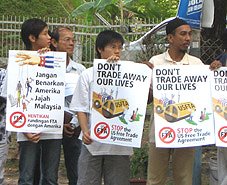
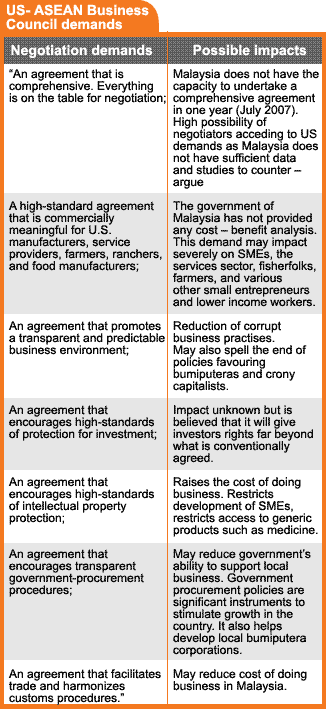
惨了!大马与美国正在进行自由贸易协定谈判,发展中国家与发达国家签署进行自由贸易,往往是发展中国家吃大亏。课堂上讲师播放的电影讲述某加勒比海小国因美国入口的奶粉价格低于本国生产的鲜奶(美国政府给予美国农产品极高的津贴),导致牛奶供应商必须将数加仑的牛奶倒掉、养牛人忍痛杀掉奶牛,......小国将任大国宰割,人民的日子将越来越难过,当政府无法再保护人民的时候,人民必将要学习反抗了!我担心,当大多数人的日子越来越难过的时候,那一群精英兼利益集团会不会再次妖言惑众,把罪名套在向来自力更生的大马华人身上?政棍们! 悬崖勒马吧!
Bad news! Malaysia and the United States began their first round of talks on a bilateral FTA. From the experience of other FTA between developed and developing countries, Malaysian's livelihood will be badly affected by Free Trade Agreement eventually. When all the barriers to trade were taken away - in fact, all the protection to people livelihood was traded away by the government, people must stand up to fight back! There are too many "trade tragedies" in many poor and developing countries, people are suffering because of FTA. In some countries, fresh milk were thrown away because the imported milk powder subsidized by the US government is cheaper than local produced milk. I am worried about when people's livelihood was ruined, will those elites/interest groups going to blame on Chinese ethnic groups that always live independently in the country again? Whose faults?
http://www.ftamalaysia.org/
http://www.malaysiakini.com
http://www.merdekareview.com/news.php?n=1912
http://www.merdekareview.com/news.php?n=1917
http://www.merdekareview.com/news.php?n=1925
http://www.merdekareview.com/news.php?n=1916
2006/06/08
A Sad open letter to the PM
Dear Prime Minister Abdullah,
When you first came into power after the 2004 general election, you promised us that you would be prime minister for all Malaysians.
In fact, I still have the letter you sent out to voters before the elections that promised you would fulfill your duties with sincerity, integrity, efficiency and fairness.
It was a letter that moved people, including staunch Opposition supporters.
There was hope that a new leadership which was more conciliatory, more willing to listen to differing views and more just was in store for the country.
And people invested in that hope by voting the Barisan Nasional back into power with a clear majority.
But recent events, including your administration's reactions to these events, have been deeply troubling.
The most recent has been the disruption of a peaceful and legitimate public forum in Penang organised by a group of non-governmental organisations that wanted to help people reclaim their rights under the Federal Constitution.
It was unfortunate, but really no longer inconceivable, that those who opposed such a civil discussion should frame their opposition in ways that incite hostility, threaten violence and make false accusations in the name of Islam, a religion that in fact promotes peace and justice. What is actually more troubling is that as prime minister, you have also publicly announced that these issues of Constitutional rights are "sensitive" and the organisers of such events must be careful not to tread on "dangerous ground", lest the government has to use the Sedition Act against them.
Why would you lend legitimacy to the argument that Malaysians should steer clear of discussing issues which affect us all as citizens, whether Muslim or non-Muslim?
By continuously telling Malaysians these issues are "sensitive" and "dangerous", isn't your administration really creating a self-fulfilling prophecy? Aren't you in fact supporting the argument that these issues should not be discussed?
Additionally, Malaysians have been reminded by Minister in the Prime Minister's Department Datuk Seri Mohamed Nazri Abdul Aziz that it's not for no reason that the word "amok" comes from the Malay community. Non-Muslims - and that easily translates to non-Malays in this country - are told we cannot speak out about the way Islam is used to formulate laws and public policies in this country even though they affect all of us.
We are told that not just the Sedition Act can be used, so can the Internal Security Act which allows for detention without trial.
In fact, I found it deeply paradoxical that Nazri could repeat the threat of the ISA at an international meeting of experts on Islam and human rights last month.
How can an unjust law be Islamic? We know it cannot, and yet, it would seem your administration is wielding it as a way to silence citizens in a democracy.
The way I see it, naming something "sensitive" and "dangerous" is just a disingenuous way of saying, "This is not open for dialogue and discussion. We might tolerate your views but only to a certain extent."
What that extent is, is left to be seen. We hope your election promises will be kept for all Malaysians, but really, many of us are more fearful than reassured.
From a non-Muslim perspective, the events leading up to the need for public discussions such as the Article 11 forum in Penang, have been disconcerting and troubling.
The painful injustice suffered by S. Shamala who found that her estranged husband could unilaterally convert their children to Islam, and the widow of M. Moorthy who discovered she could not bury her husband according to Hindu rights, are real and frightening.
But those instances of injustice are not being framed as "sensitive" by non-Muslims. They are not being used to threaten violence or incite hostility in order to silence discussion of the issues at hand.
Additionally, when you upheld the decision for the tudung to be used in police parades, did you consider how it would make non-Muslims feel? How can it still be a surprise then that most non-Malays will not join the police force?
Really, I don't need to be a Muslim or a Malay to have a stake in this country. But even that might be delegitimised because in more ways than one, I'm a minority.
And I'm constantly reminded that my views and concerns must give way to the privileges and rights of the dominant race, and a specific interpretation of the faith they profess.
But really what I want to ask you is this: Why do I have to constantly feel afraid in my own country? Why am I continuously told I have less rights to discuss important issues affecting my community?
You promised to be prime minister for all Malaysians. We hope you will remember that promise.
When you first came into power after the 2004 general election, you promised us that you would be prime minister for all Malaysians.
In fact, I still have the letter you sent out to voters before the elections that promised you would fulfill your duties with sincerity, integrity, efficiency and fairness.
It was a letter that moved people, including staunch Opposition supporters.
There was hope that a new leadership which was more conciliatory, more willing to listen to differing views and more just was in store for the country.
And people invested in that hope by voting the Barisan Nasional back into power with a clear majority.
But recent events, including your administration's reactions to these events, have been deeply troubling.
The most recent has been the disruption of a peaceful and legitimate public forum in Penang organised by a group of non-governmental organisations that wanted to help people reclaim their rights under the Federal Constitution.
It was unfortunate, but really no longer inconceivable, that those who opposed such a civil discussion should frame their opposition in ways that incite hostility, threaten violence and make false accusations in the name of Islam, a religion that in fact promotes peace and justice. What is actually more troubling is that as prime minister, you have also publicly announced that these issues of Constitutional rights are "sensitive" and the organisers of such events must be careful not to tread on "dangerous ground", lest the government has to use the Sedition Act against them.
Why would you lend legitimacy to the argument that Malaysians should steer clear of discussing issues which affect us all as citizens, whether Muslim or non-Muslim?
By continuously telling Malaysians these issues are "sensitive" and "dangerous", isn't your administration really creating a self-fulfilling prophecy? Aren't you in fact supporting the argument that these issues should not be discussed?
Additionally, Malaysians have been reminded by Minister in the Prime Minister's Department Datuk Seri Mohamed Nazri Abdul Aziz that it's not for no reason that the word "amok" comes from the Malay community. Non-Muslims - and that easily translates to non-Malays in this country - are told we cannot speak out about the way Islam is used to formulate laws and public policies in this country even though they affect all of us.
We are told that not just the Sedition Act can be used, so can the Internal Security Act which allows for detention without trial.
In fact, I found it deeply paradoxical that Nazri could repeat the threat of the ISA at an international meeting of experts on Islam and human rights last month.
How can an unjust law be Islamic? We know it cannot, and yet, it would seem your administration is wielding it as a way to silence citizens in a democracy.
The way I see it, naming something "sensitive" and "dangerous" is just a disingenuous way of saying, "This is not open for dialogue and discussion. We might tolerate your views but only to a certain extent."
What that extent is, is left to be seen. We hope your election promises will be kept for all Malaysians, but really, many of us are more fearful than reassured.
From a non-Muslim perspective, the events leading up to the need for public discussions such as the Article 11 forum in Penang, have been disconcerting and troubling.
The painful injustice suffered by S. Shamala who found that her estranged husband could unilaterally convert their children to Islam, and the widow of M. Moorthy who discovered she could not bury her husband according to Hindu rights, are real and frightening.
But those instances of injustice are not being framed as "sensitive" by non-Muslims. They are not being used to threaten violence or incite hostility in order to silence discussion of the issues at hand.
Additionally, when you upheld the decision for the tudung to be used in police parades, did you consider how it would make non-Muslims feel? How can it still be a surprise then that most non-Malays will not join the police force?
Really, I don't need to be a Muslim or a Malay to have a stake in this country. But even that might be delegitimised because in more ways than one, I'm a minority.
And I'm constantly reminded that my views and concerns must give way to the privileges and rights of the dominant race, and a specific interpretation of the faith they profess.
But really what I want to ask you is this: Why do I have to constantly feel afraid in my own country? Why am I continuously told I have less rights to discuss important issues affecting my community?
You promised to be prime minister for all Malaysians. We hope you will remember that promise.
A Malaysian citizen.
(Jacqueline Ann Surin believes that you cannot be neutral on a moving train. She is an assistant news editor at theSun.)
2006/05/27
医院的厨房 Kitchen in the hospital
 在医院打工也有一个星期了,鸡手鸭脚的我今天还是忘了不必对厨师说明是糖尿病人的食物,只需在病人只能吃软性食物或液体食物的情况时才特别交待主厨。医院准备给糖尿病人的食物,除了甜品分成两种,主菜是适合他们的。
厨房助理工作有些繁锁,之前,我不断祈求老天爷让我找到一份有得吃的工作,那我就可以省下买食物的钱。果然,给我找到了医院这份工作,代价就是每天忙碌的4小时,没一刻喘气的机会。
最让我感到压力的是向病人落单、送上食物,深怕拿错甜品、拿错咖啡或茶,今天就差点拿了一个面包给一位只能吃液状食物的病人。此外,也要特别注意那些属于NBM(不能进食)的病人。
有时,病人喃喃自语时,我根本听不懂。一位老奶奶每次只会流着眼泪问我们:“你们打电话通知了我的先生吗?他说他会送食物过来”。这几天我值日时,我们端上的食物她从来没动过。
送完晚餐后,要再回病房收回碗碟,然后,再送上茶或咖啡或巧克力,绕一圈后,再回去收回杯子。要让厨柜保持亮晶晶,地板要干爽...
厨房的前辈们个个都很有耐心。我要小心翼翼,又担心自己怠慢。他们总是说,没关系,有一天,你会熟悉一切的。
厨师为病人准备的都是英国食物,这五天下来,英国食物的名字我都快记熟了。昨天有LASAGNE, BROCOLLI and HERB QUICHE, 今天有BRAISED SAUSAGES 和 CHEESE TORTELLINI... ...
本来,我最不愿意做的事就是倒掉食物,然而,这几个月,我一次又一次地因为工作而需要把食物倒掉。这一次,在医院把食物倒掉,那种感觉与上次在自助餐馆工作时,倒掉食物有点不同。
原来,再美味的食物,在那些没有食欲的病人面前,一点价值也没有。
我也发现,那些身边有家人的病人胃口比较好。
老天爷,也请您保佑我的家人、朋友,身体健康,平安。
#
 Today is the fifth day since I started to work in the hospital as a catering assistant. Still, I feel panic and stressful during the working hours. I am afraid that I might serve wrong food to patient who is only allowed to “soft diet”, “dysphagia soft” or “diabetes diet ”. In hospital, apart from desserts, main courses are all suitable for diabetic patients, I just need to inform the chef when the patient is soft diet or dysphagia.
Before that, I had been looking for a job that provides food, so that I do not have to spend too much on food. As a result, I’ve got the job in the kitchen of hospital. I really need to be aware of the different diets that patients have.Today, I nearly gave a roll to a patient who is on “dysphagia soft diet”. Nil By Mouth(NBM) is another type of patients who cannot eat anything.
Sometimes, it is difficult to understand when the patients are murmuring themselves. I felt sad when I saw an old lady kept asking us “Did you call my husband? … …”, these two days, she never touched the dinner.
Serving food, collecting trays, washing dishes, serving tea/coffee/hot chocolate, collecting cups, cleaning kitchen have become my daily work. Senior are nice and always tolerance, I always ask, “Am I too slow?”they always tell me : “Don’t panic, you are good.” , when I forgot something, they said, “Don’t worry, you will reach there one day.” They always call each other “sweetheart”, “dear”, “darling”, and “babe”, like a family. Maybe because hospital is a sensitive area, therefore, people are trying to create a happy working environment to avoid any unpleasant incidents.
This is also a good chance to make myself familiar with British food. I can now remember the names like Lasagne, Broccoli and Herb Quiche, Braised Sausages, Cheese Tortellini... ...
When I saw those patients who have no appetite to eat, and I have to throw the food away, the feeling is different from when I worked and threw away the food in the buffet restaurant. Suddenly, I realized that our health is so important.
2006/05/17
"Who is Afraid of the Last Communist?"

-- None of those who protested against this documentary has seen it.
-- It can even be screened in Singapore, but not in Malaysia, Why?
-- Writer/Director/Producer : Amir Muhammad
PG, 90minutes, Malay/Chinese dialects/Tamil with English subtitles
"... ... If anything, Chin Peng and the MCP should be remembered for what they were: partners in the collective attempt to free Malaya and Malayans from the yoke of British colonialism and Western imperialism. The British understood very well why the Malayan Communist Party was a threat to their own imperial and colonial interests, for the Communists were hardly allies who could be counted upon to defend the rights and privileges of the colonisers. Instead the British chose to support the liberal Malayan conservatives like Onn Jaafar who later created the Independence for Malaya Party (IMP) that was little more than a soft bulwark against the tide of growing anti-colonial sentiment spreading through the country and the region by extension.
During its heyday, the Malayan Communist Party was part of a greater international coalition that struggled against both colonialism and imperialism and which regarded Fascism as its greatest enemy. While the liberals and conservatives among our forefathers lay dormant, the Malayan Communists were the ones who stood up against both Japanese militarism, and following the Second World War, the attempt by the former colonial powers to reimpose their imperial rule in Asia. Were these 'sins' that they, and us, should be ashamed of?
To return to the original question posed at the beginning: If Amir Muhammad's film on Chin Peng is deemed as unfit or even dangerous for the Malaysian public, we need to ask ourselves whose interests are being served here? The Malaysian public that still has to learn the true extent of the commitment and sacrifice of all Malaysians from all races and all walks of life in the anti-colonial struggle? Or the interests of the conservatives among us who insist that theirs and theirs alone is the official account of Malaysian history that deserves to be told? One can understand how and why the British colonisers were adamant that the Malayan Communist Party should be destroyed and all traces of it wiped out. But why should the same skewered beliefs be held by the Malaysian political elite of today? " --- by Farish A Noor is a Malaysian political scientist and human rights activist, based at the Zentrum Moderner Orient (ZMO), Berlin. The above article was written for Eye Asia.
2006/05/14
噪音 Noise
以前在中国读书的时候,每天晚上过了11点半,全栋宿舍都必须熄灯,每间房只能开桌灯。有时和学姐聊天聊得过瘾时,声音大了一点,隔壁房的澳门学生就会敲门、敲窗口:“烦麻小声一点!”。 再不然就是巡房的阿姨会来敲门:“好夜了,小声一点。”考试期间,如果有那一间房“炸机”(玩音响),就会被别的同学大声回应:“好吵啊!收声啦!!”
在英国,与国际学生相处,有时真的不知如何是好,午夜12点,是我开始进入梦乡的时间,却是他们开始召集人马,来宿舍吃晚餐的时间。上个月,我在赶论文期间,他们在厨房喧哗,完全当其它室友不存在。他们其实对人都很友善,很热心,可就是喜欢三更半夜把别人吵醒却不当一回事。我的日本、大马、中国同学在学校内宿舍也大吐口水,为什么那么他们爱开派对?
现在,每当我的室友玩音响时,播放我根本不懂得欣赏的、却掩盖过我的音乐时,有时,我会出去说一声,有时,我只是拿起耳套听音乐,继续读书。在这个完全依赖自制的环境里,我竟然开始怀念那种“军人式”的秩序。或许,文化差异不能靠谈判解决,文化是内化的过程。
When I was studied in China, every night after 11pm, we were required to switch off our light in the room, only desk lamps were allowed. Sometimes, if we talked a bit louder in our room,
my Macau flatmates lived next door would come and knock at our door or window :"please keep your voice down." The accommodation officer who was patrolling would also say:"It is late now, keep your voice down." During the examination, whenever somebody tried to play her Hi-fi,there must be somebody else shouted:"it is too noisy, turn it off!!!"
In the UK, I am having a different experience with international students. During the midnight, when it is time to sleep for me, they begin their dinner. Last month, when I was stuck at my essay and deadline was approaching, they were having party in the kitchen. They are all friendly and helpful friends, but I cannot find a proper reason to explain why they cannot realize there are residents in this flat who need to sleep, and it seems that they didn't realize they have awaken somebody else in the midnight. Some of my Asian friends are also facing the similiar dilemma.
Now, whenever there is music that I don't know how to appreciate playing "on air", I will use my ear plug to avoid it, sometimes, if it covered the music in my room and disturbed my work, I will speak out. In this environment that requires self-discipline, ironically, I begin to miss those days with lots of rules and regulations. Perhaps, cultural is something that rooted internally, we need more rather than negotiation when there is cultural clash.
#
在英国,与国际学生相处,有时真的不知如何是好,午夜12点,是我开始进入梦乡的时间,却是他们开始召集人马,来宿舍吃晚餐的时间。上个月,我在赶论文期间,他们在厨房喧哗,完全当其它室友不存在。他们其实对人都很友善,很热心,可就是喜欢三更半夜把别人吵醒却不当一回事。我的日本、大马、中国同学在学校内宿舍也大吐口水,为什么那么他们爱开派对?
现在,每当我的室友玩音响时,播放我根本不懂得欣赏的、却掩盖过我的音乐时,有时,我会出去说一声,有时,我只是拿起耳套听音乐,继续读书。在这个完全依赖自制的环境里,我竟然开始怀念那种“军人式”的秩序。或许,文化差异不能靠谈判解决,文化是内化的过程。
When I was studied in China, every night after 11pm, we were required to switch off our light in the room, only desk lamps were allowed. Sometimes, if we talked a bit louder in our room,
my Macau flatmates lived next door would come and knock at our door or window :"please keep your voice down." The accommodation officer who was patrolling would also say:"It is late now, keep your voice down." During the examination, whenever somebody tried to play her Hi-fi,there must be somebody else shouted:"it is too noisy, turn it off!!!"
In the UK, I am having a different experience with international students. During the midnight, when it is time to sleep for me, they begin their dinner. Last month, when I was stuck at my essay and deadline was approaching, they were having party in the kitchen. They are all friendly and helpful friends, but I cannot find a proper reason to explain why they cannot realize there are residents in this flat who need to sleep, and it seems that they didn't realize they have awaken somebody else in the midnight. Some of my Asian friends are also facing the similiar dilemma.
Now, whenever there is music that I don't know how to appreciate playing "on air", I will use my ear plug to avoid it, sometimes, if it covered the music in my room and disturbed my work, I will speak out. In this environment that requires self-discipline, ironically, I begin to miss those days with lots of rules and regulations. Perhaps, cultural is something that rooted internally, we need more rather than negotiation when there is cultural clash.
#
2006/05/13
Whose feelings hurt?
2006-03-31 19:32:12 MYT
By Tay Tian Yan Sin Chew Daily
To be frank, I deeply understand Loh Seng Kok's grief at this moment.
A few nights ago, about 50 well-built men dashed into the MP's service centre, throwing behind a letter, saying, "We do not want to listen to your explanations. This is our letter. Reply us after reading it."
This group of people also threatened that if Loh did not reply within a few days, he would have to face some "action."
What happened there shocked the centre's staff and everyone around it.
I have to make it very clear that, as what I know, these people are not gangsters; neither are they running for loansharks, although what they did would have given people such an impression.
It is learned that they are from Kelana Jaya UMNO Youth, fellow BN members from Loh's constituency. Of course, everyone knows that Loh is MCA's elected representative for this constituency.
What has Loh Seng Kok done that his BN "partners" should come after him, and issue him an ultimatum? Has he failed his voters? Or something has gone wrong with his job or morality?
Not quite!
The problem is that Loh has said something, which has over the past 50 years been swept under the carpet in the name of "sensitivity." His words have cautioned some people, making them feel embarrassed and irritated.
But at least to me, what he said was the content of his heart.
While commending the government's many achievements in his speech at Dewan Rakyat, he also expressed many of his feelings during his two-decade political life, as well as some propositions.
He said the country's history textbooks had largely overlooked the contributions made by non-bumiputras. For instance, on the resistance against the Japanese occupation, he said history textbooks only touched on the resistance put up by the Malays, and fell short of mentioning the resistance put up by the Chinese and Indian communities here. On top of that, the textbooks only emphasised Malay culture and Islamic civilisation but not the culture and civilisation of other ethnic groups.
He also mentioned the dilemma faced by non-Muslims in this country. He said Buddhists, Christians, Catholics and Taoists not only lacked places of worship, they also had to come to terms with situations such as demolition of places of worship and revocation of worship licences. He suggested that the Government establish a cross-religious agency to help resolve these problems.
As for a prayer guideline issued by the Islamic Development Authority to be implemented on all official and semi-official functions, he said prior consultation had not been sought with representatives from other religions, violating the country's multicultural and multireligious principles.
I do not have to quote further. I only want to say that all these are truths, which we all have been familiar with. As a Barisan MP, Loh was only expressing the views of his constituents by telling the truth in the Parliament.
I dare say that over the past few years, among the so many debate speeches by Barisan MPs in the Parliament, his was among the very few which are of some value and ought to be taken seriously.
However, Loh was straightaway warned by UMNO MPs for his speech, and later challenged by UMNO Youth members from his very own constituency. They claimed that Loh had "hurt the feelings of the Malays."
But who have been hurt if all that he said was the unfair treatment and dilemma slapped onto the country's Chinese community? Who can really represent the Malays? The infuriated Mohd Aziz who served him the warning in the Parliament? Or Abdul Halim who led some 50 people to storm his service centre? Or rather the multitude of unnamed Malays who accept that Malaysia is a multicultural society, and who respect various religions, values and historical facts?
While the entire world is beginning to accept openness, tolerance, justice and democracy as key values, why is such a group of narrow-minded people allowed to continue bewildering the public and corrupting our systems?
The Barisan structure has been in existence for decades, but where is the space for consultation among the component parties? A rational and objective reasoning in the Parliament is not accepted and tolerated. If BN leaders allow such malicious suppression to go on, that would be the regression of BN mechanism, and the submergence of the country's multicultural values.
I was thinking, if the ultimatum issued to Loh were not appropriately dealt with, that would not only be his grief, but that of the entire nation too.
A few nights ago, about 50 well-built men dashed into the MP's service centre, throwing behind a letter, saying, "We do not want to listen to your explanations. This is our letter. Reply us after reading it."
This group of people also threatened that if Loh did not reply within a few days, he would have to face some "action."
What happened there shocked the centre's staff and everyone around it.
I have to make it very clear that, as what I know, these people are not gangsters; neither are they running for loansharks, although what they did would have given people such an impression.
It is learned that they are from Kelana Jaya UMNO Youth, fellow BN members from Loh's constituency. Of course, everyone knows that Loh is MCA's elected representative for this constituency.
What has Loh Seng Kok done that his BN "partners" should come after him, and issue him an ultimatum? Has he failed his voters? Or something has gone wrong with his job or morality?
Not quite!
The problem is that Loh has said something, which has over the past 50 years been swept under the carpet in the name of "sensitivity." His words have cautioned some people, making them feel embarrassed and irritated.
But at least to me, what he said was the content of his heart.
While commending the government's many achievements in his speech at Dewan Rakyat, he also expressed many of his feelings during his two-decade political life, as well as some propositions.
He said the country's history textbooks had largely overlooked the contributions made by non-bumiputras. For instance, on the resistance against the Japanese occupation, he said history textbooks only touched on the resistance put up by the Malays, and fell short of mentioning the resistance put up by the Chinese and Indian communities here. On top of that, the textbooks only emphasised Malay culture and Islamic civilisation but not the culture and civilisation of other ethnic groups.
He also mentioned the dilemma faced by non-Muslims in this country. He said Buddhists, Christians, Catholics and Taoists not only lacked places of worship, they also had to come to terms with situations such as demolition of places of worship and revocation of worship licences. He suggested that the Government establish a cross-religious agency to help resolve these problems.
As for a prayer guideline issued by the Islamic Development Authority to be implemented on all official and semi-official functions, he said prior consultation had not been sought with representatives from other religions, violating the country's multicultural and multireligious principles.
I do not have to quote further. I only want to say that all these are truths, which we all have been familiar with. As a Barisan MP, Loh was only expressing the views of his constituents by telling the truth in the Parliament.
I dare say that over the past few years, among the so many debate speeches by Barisan MPs in the Parliament, his was among the very few which are of some value and ought to be taken seriously.
However, Loh was straightaway warned by UMNO MPs for his speech, and later challenged by UMNO Youth members from his very own constituency. They claimed that Loh had "hurt the feelings of the Malays."
But who have been hurt if all that he said was the unfair treatment and dilemma slapped onto the country's Chinese community? Who can really represent the Malays? The infuriated Mohd Aziz who served him the warning in the Parliament? Or Abdul Halim who led some 50 people to storm his service centre? Or rather the multitude of unnamed Malays who accept that Malaysia is a multicultural society, and who respect various religions, values and historical facts?
While the entire world is beginning to accept openness, tolerance, justice and democracy as key values, why is such a group of narrow-minded people allowed to continue bewildering the public and corrupting our systems?
The Barisan structure has been in existence for decades, but where is the space for consultation among the component parties? A rational and objective reasoning in the Parliament is not accepted and tolerated. If BN leaders allow such malicious suppression to go on, that would be the regression of BN mechanism, and the submergence of the country's multicultural values.
I was thinking, if the ultimatum issued to Loh were not appropriately dealt with, that would not only be his grief, but that of the entire nation too.
2006/05/10
从水务法案危机上一堂课 Lessons from Water Bills Crisis
(此文已于2006年5月10日发表在《独立新闻在线》,网址-http://www.merdekareview.com/news.php?n=1692)
国际贸易与工业部长拉菲达在世贸组织签署了一份内容不详、但极有可能让跨国财团控制我国资源的《服 务贸易总协定》,而能源、水务与通讯部长林敬益却在国内安抚大家说:“水供绝对不会落到跨国集团手里。”国会如今已通过水务业法案二读,大家将眼睁睁看着 他们如何让国家对资源的掌控权陷入危机。
国际贸易与工业部长拉菲达在世贸组织签署了一份内容不详、但极有可能让跨国财团控制我国资源的《服 务贸易总协定》,而能源、水务与通讯部长林敬益却在国内安抚大家说:“水供绝对不会落到跨国集团手里。”国会如今已通过水务业法案二读,大家将眼睁睁看着 他们如何让国家对资源的掌控权陷入危机。
今天,大家要记得这些将公共资源私营化、将商业利益置于人民权益之上、拥抱新自由主义经济制度的 “亡国部长”,他们公然让属于全民的天然资源成为商品及一小撮人赚钱的工具,并且毫无意图白纸黑字写下水供只能由国家继续控制的条款,这绝对是让跨国集团 可能控制我国水源的裂口。
让各州水供私营化,让每个生命赖以为生的水源成为可以买卖的商品,已是一次遗祸无穷的“掠夺”,因为连首相阿都拉 巴达威也默许公共工程无需公开投标,已经暗示人民谁将是公共领域私营化的真正获益者。但看水供公司如今竟有权在用户不缴水费后切断水供,而缴付水费的消费 者却别无选择、必须继续购买不清洁的自来水,还要自掏腰包装置上千元的过滤器,清洁的水已经成为一种奢侈品。
垄断是让人民“别无选择”的根 源,人民根本无权选择让谁管理公共水源、无权选择使用更加廉价和清洁的水,也无权选择到住家附近的河里汲水,因为河流已经在现代化及工业化的过程中被污 染,而修复河流的费用往往是像我国这样的政府极度不愿意投入的亏本生意。更可怜的是,五年一度的选举,让我们选出一些只会用双手遮住眼睛、蒙住双耳、捂住 嘴巴的所谓“人民代表”,然后还要听像林敬益这位资深部长的抱怨及反问:“如果由政府接管水务,州水务公司清盘了,接管的国家水务局该怎么做?”
还有,在国际谈判桌上的会谈结果、文件,怎么能凭几个人说了算?拉菲达签下她的大名之前,是否让国内受影响的人民了解文件内容、会谈过程?我国政府到底在《服务贸易总协定》下了什么保单?
私营化是新自由主义最影响民生一环
私 营化是新自由主义经济政策中最直接影响民生问题的一环,追根究底,新自由主义是资本主义发展中,资本继续累积、扩张的表现,倡议者相信:国家必须最低限度 的管制、最高度的开放市场,无管制的自由市场能促进自由及公平的竞争,进而取得经济发展。因此,私营化最初的理想是通过竞争提高服务效率,其另一层涵义就 是将公共资源(如:水源、石油、教育、医院)商品化,然而,实践起来,水供私营化在世界各地都引发民怨,无论是发展中国家或是先进国,都面对私人公司通过 非法手段获取水供合约、为谋利减低营运费、水源污染、水价高涨等问题。
世界银行、国际货币基金组织及世界贸易组织可说是新自由主义经济的推 销员。这个中心思想完全在世行“拯救贫穷计划”的借贷条件――“结构调整政策”的10大策略有迹可寻,除了私营化,还包括货币自由浮动、贸易自由化、削减 政府在卫生及教育的开销、确保私有产权、 让外资自由进出、解除环境保护等不利投资者的管制。
要知道新自由主义经济理论引发的矛盾及问题, 我们必须将视野放到西半球。追溯回1970年代,美国为了抑制国内通膨,不惜提高利息,拖累了拉丁美洲国家,这些国家的债务当时一翻12倍;至今,拉美各 国连利息都未还清。拉丁美洲各国做为新自由主义的实验厂,在结构调整政策中,饱受贷款国通过借贷条件强加于他们身上的经济政策,换来的是贫富悬殊、高通 膨、高失业率、天然资源落入跨国公司手里,环境被破坏,政府做为人民赋予权力管理公共财产及分配公共资源的角色被削弱,弱势群体继续处于劣势。
有 人认为:“既然本国公司做不好,交给外国人去管算了!”新自由主义一系列政策是资本主义发展的资本累积及扩张方式,这是一种新式的掠夺,在其驱动下的全球 化,就是跨国财团如何趁着各国政府(自愿或被迫)削弱工会组织力量、放松环境、企业管制后,强占别人的土地、生存环境。认清所谓“全球500强企业”不是 创造就业机会,而是迫使更多人交出赖以为存的土地、出卖劳力-被剥削的机会。
受国内法律约束的私化营公司都可以为所欲为,我们如何确保在被 迫开放水供给外国企业财团后,不会任人宰割?跨国财团凌驾国家法律的事情已经上演,墨西哥签署北美自由贸易协定后,它的一个省份在2001年因制订了保护 当地人民的环境管制条约,遭到一家跨国财团以“妨碍投资”为名起诉而必须赔偿九千万美元!
该管的不管,选举制度要来干么?
从 个人到社会、从社会到国家、从国家到全球,每个人类单位的文明起步及社会发展从一开始步伐就不一样,公平竞争的自由市场根本不可能实现,也不可能保障以出 卖劳动换取生活必需品的人民的权益。诺贝尔奖得主、世界银行前经济学家史蒂利兹已指出:“一波又一波的金融风波正是无管制竞争市场的结果。”因此,“政 府”做为唯一受人民委托来管理社会及公共资源的单位,在资源分配的工作上必须负起更大的责任,简单地说:“选你出来,该管的你不管,选举制度要来做什 么?”
资本主义发展史上,通过掠夺进行的资本累积必将遭遇受压迫人民的反抗。30多年前,新自由主义经济理论在世界银行及国际货币基金组织 的“灌溉”下已经结出恶果,腐败的私营化政策、自由贸易、开放外资、加上国家负债累累,拉丁美洲老百姓生活素质每况愈下,最终换来1990年代开始的醒 觉。它们的人民及国家领袖正在做出反抗。最近,委内瑞拉、波利维亚及古巴 联合签署了“美洲玻利瓦尔替代方案 (Bolivarian Alternative for the Americas, ALBA) ”以及 “人民贸易协定 (People’s Trade Agreement, TPC) ”,以抗衡由美国主导的“北美自由贸易协定(NAFTA)”。除了委内瑞拉总统查韦斯公然挑战美国的霸权,波利维亚新任总统莫拉莱斯上任后既制定新法重夺 该国对石油及天然气控制权,并派军驻守油库。
1999年国际上著名的“西雅图反世贸、反(企业)全球化活动”,及那之后的“世界社会论坛” 见证了弱势群体站在国际舞台上企图打破“自由市场”能解救贫穷的神话。拉丁美洲各国与北美经济、政治的千丝万缕短期内固然不能完全切断,但行动上至少敲一 敲那些推行新自由主义经济的脑袋:“嘿,你那一套害了我们三代人,我们现在要走自己的路!”现阶段,拉美各国正努力从跨国财团手中索回国家对天然资源的主 权。
国内,我们只见林敬益不断地口头上保证绝不将水源控制权交出给外国公司,却不见任何将这个承诺列入法案的行动。拉菲达呢?只有天晓得她 在国际谈判桌上签下什么文件,我们凭什么相信这位连汽车入口准证问题都左躲右闪的部长能保障我们的权益?这些掌控多数资源的少数精英可以继续利用代议士民 主无法询问每一个人的缺陷、通过践踏人民的血汗及眼泪,将手段当成目的,继续保障自己拥有的一切。
从内阁部长及在朝议员无人过问水源控制权 的问题看来,1998年勇敢对国际货币基金组织说不的大马政府,为保利益集团袋袋平安,政府仍热衷于私营化,如今不惜弃守水源控制权,无知也罢,无能也 罢,伴随近50年的政治、经济的垄断,遗害万年的种族论,人民现在还不恼火,还不行动阻止,难道还要另一个30年换取醒觉及反抗?
尽管有缺陷的法案已经通过,这不代表没有机会改变,人民还要学习许多挑战及反抗的方式,要知道,我们不是孤军作战,因为世界各地正在展开反新自由主义、反经济全球化运动,不要说你不相信拉丁美洲几个自身难保的国家能改变大趋势,没有任何改变是一朝一夕的。
Recently, Minister for International Trade Rafidah Aziz has signed the General Agreement on Trade in Services (GATS), people are worried that water industry would fall into the hands of foreigners. At the same time, Energy, Water and Communications Minister Dr Lim Keng Yaik has been trying to ensure verbally that the bills would not pose a threat to the nation’s sovereignty. However, the disputable Water Services Industry Bill (WSI) and the National Water Services Commission (Span) Bill were eventually passed in the Dewan Rakyat, we had witnessed how our government put the nation’s sovereignty of our natural resources in a critical position.
We must not forget how these ministers tried to privatize our public resources; they embrace neo-liberalism economic and allow the commercial profit come before people’s interest. Public natural resources have turned into commercial goods, and now, they have no intention of writing down any provision to retain water management under government authority in the water bills.
Water is our basic needs. The water privatization and commercialization in every state is a form of dispossession. When our PM gave his consent to the award of public construction contracts without open tender, it is patently obvious that who benefits from the privatization of public goods. Today, the private water companies have the right to terminate the water supply if consumers fail to pay their water bill, but consumers have no choice when they are supplied with unclean water, they even have to pay their own bill to install water filters, in that way, clean water has become luxury goods.
Monopoly leaves people without choices. We cannot choose people who manage our water supply, we have no other choices to access to clean and safe water. We cannot bail water from the river nearby our house as well because it has been polluted in the process of the modernization and industrialization. The cost of rehabilitating the polluted rivers is always uneconomical for our government which only cares about the profit from every project. Meanwhile, we have to suffer to the nagging of the people’s representatives like our senior Minister Lim Keng Yaik: if government takes over the water, state water companies have to wind up, how should National Water Services Commission do?
In addition, what are the contents of the GATS? Have they ever explain to the people in the country that might be affected before they sign any international trade agreements?
In neo-liberalism economic policies, privatization affects directly the livelihood of the people at most. Neo-liberalism manifests itself through the expansion and accumulation of capital in capitalism. Neo-liberalism is an economic ideology which promotes minimizing the intervention of government, and maximizing the liberalization of free market. Advocates believe that unregulated free market can accelerate free and fair competition, a country can achieve its economic growth in the end. Therefore, the initial ideal of privatization is to improve the effectiveness of the public services, in the other words, to commercialize the public goods such as water, oil, education and hospital. Unfortunately, in practice, water privatization has caused the resentment from people all over the world in both developed and developing countries. The problems that often arise include the illegal and a lack of transparency in awarding the water contract, cutting down the cost of maintenances, water pollution and rising water tariff.
World Bank(WB) , International Monetary Fund (IMF ) and World Trade Organization (WTO) can be seen as the sale-representatives of neo-liberalism. We can trace the main ideas of neo-liberalism in strategies of the Structure Adjustment Programme (SAPs)- a series of programs to eliminate poverty, which include trade liberalization, cutting down public expenditure, financial liberalization, protection on property rights, liberalization of foreign direct investment and deregulation on social protection.
To study the contradictories and inconsistencies in neo-liberalism economic policies, we have to take a look at the Latin Americas(LAs) countries. Back in the 1970s, the US increased its interest rates to address the problems of inflation and to improve their competitiveness; LAs were burdened with huge debts since then. Under the SAPs imposed by the donor countries, LAs have been suffering from wide huge gap between the rich and the poor, high inflation rate, high unemployment rate, natural resources controlled by foreign companies, environment degradation, the nation’s sovereignty has been weakened.
Some people say: “I would rather buy clean water from foreign companies!” Neo-liberalism is the way of capital accumulation and expansion in the development of capitalism, this is a new form of dispossession. Globalization driven by this trend is substantially giving a chance to multinational companies to occupy common lands and people livelihoods after the countries were forced to weaken their workers’ unions, and abolishing regulations formulated for environmental reasons. The so-called “global 500 corporations” are not providing job opportunities but forcing the powerless to give up their lands, on which they depend - means of existence- and live upon selling their labour- to be exploited.
Even the local private companies had failed in abiding our national laws and regulations, how do we ensure the benefits of the commons if we are forced to liberalize our water industry to foreign company? There are a lot of examples where multinational companies superseded a country’s legislative. For instance, in 2001, one of the provinces in Mexico was ordered to compensate 90million dollars to a multinational company under the conviction of “expropriating” its investment because the local government has regulated some environmental laws to protect local people.
From an individual, a society, a country, to global, there are big differences between every society and the process of development, it is impractical to push fair competition in every society, it is also impossible to ensure the rights of people to access to their basic needs through free market. Nobel laureate Joseph Stiglitz has already pointed out that unregulated markets competition is the cause of financial crisis. Therefore, governments have great responsibilities in managing and distributing public assets and social resources. In a nutshell: “if you are reluctant to bear these responsibilities, what’s the purpose of electoral system? ”
In capitalism, enclosure and accumulation by dispossession is a process of unifying the oppressed. Three decades ago, the neo-liberalism imposed by the WB and IMF has brought numerous evil consequences such as corruption in privatization, heavy debts and the low quality of standard of living. Those nations began to resist in the 1990s. Recently, Venezuela, Bolivia and Cuba signed Bolivarian Alternative for the Americas(ALBA ) and People’s Trade Agreement(TPC). The president of Venezuela has criticized the US publicly, the new president of Bolivia Mr.Morales wanted to renegotiate of existing contracts on terms that would provide a greater share of the revenues for the state.
During 1999, there were anti-IMF and anti-globalization(anti-corporation) movements in Seattle, NGOs that gathered at World Social Forum was trying to make a clear voice that the free market cannot eliminate poverty.
Back to Malaysia, there is no action to amend the water bill, making it easier for foreigners to enter and take over the water sector. Only god knows what sort of agreement had been signed by Rafidah in trade negotiation, how do we believe a minister like her- still remains tight-lipped on APs scandal- can safeguard people’s rights and interests?
No member of parliament shows their concern about the control of our water, our government that have bravely rejected the conditional aid provided by IMF in 1998, nowadays have gave up their rights of controlling our resources in order to protect their cronies. If we still ignorant to the 50 years of political and economical dominance, and racism, are we going to endure for another 30 years ?
However, it is important to notice that we still stand the chance to change, we need to learn to challenge and resist, because it is a trend now, there are anti-neoliberalism and anti-globalization movements all over the world. It is still early to say that countries in LAs will not succeed, because nothing is changed overnight.
#
Subscribe to:
Posts (Atom)